
Paul and Barnabas' Ministry and Persecution
Paul and Barnabas, facing opposition and hardship, spread the Gospel throughout the Roman Empire. Their journey is a testament to faith and perseverance.
Paul and Barnabas' Ministry and Persecution
Acts
13:1-46
1. Now there were in the church that was at Antioch certain prophets and teachers; as Barnabas, and Simeon that was called Niger, and Lucius of Cyrene, and Manaen, which had been brought up with Herod the tetrarch, and Saul.
2. As they ministered to the Lord, and fasted, the Holy Ghost said, Separate me Barnabas and Saul for the work whereunto I have called them.
3. And when they had fasted and prayed, and laid their hands on them, they sent them away.
4. So they, being sent forth by the Holy Ghost, departed unto Seleucia; and from thence they sailed to Cyprus.
5. And when they were at Salamis, they preached the word of God in the synagogues of the Jews: and they had also John to their minister.
6. And when they had gone through the isle unto Paphos, they found a certain sorcerer, a false prophet, a Jew, whose name was Bar-jesus:
7. Which was with the deputy of the country, Sergius Paulus, a prudent man; who called for Barnabas and Saul, and desired to hear the word of God.
8. But Elymas the sorcerer (for so is his name by interpretation) withstood them, seeking to turn away the deputy from the faith.
9. Then Saul, (who also is called Paul,) filled with the Holy Ghost, set his eyes on him,
10. And said, O full of all subtilty and all mischief, thou child of the devil, thou enemy of all righteousness, wilt thou not cease to pervert the right ways of the Lord?
11. And now, behold, the hand of the Lord is upon thee, and thou shalt be blind, not seeing the sun for a season. And immediately there fell on him a mist and a darkness; and he went about seeking some to lead him by the hand.
12. Then the deputy, when he saw what was done, believed, being astonished at the doctrine of the Lord.
13. Now when Paul and his company loosed from Paphos, they came to Perga in Pamphylia: and John departing from them returned to Jerusalem.
14. But when they departed from Perga, they came to Antioch in Pisidia, and went into the synagogue on the sabbath day, and sat down.
15. And after the reading of the law and the prophets the rulers of the synagogue sent unto them, saying, Ye men and brethren, if ye have any word of exhortation for the people, say on.
16. Then Paul stood up, and beckoning with his hand said, Men of Israel, and ye that fear God, give audience.
17. The God of this people of Israel chose our fathers, and exalted the people when they dwelt as strangers in the land of Egypt, and with an high arm brought he them out of it.
18. And about the time of forty years suffered he their manners in the wilderness.
19. And when he had destroyed seven nations in the land of Chanaan, he divided their land to them by lot.
20. And after that he gave unto them judges about the space of four hundred and fifty years, until Samuel the prophet.
21. And afterward they desired a king: and God gave unto them Saul the son of Cis, a man of the tribe of Benjamin, by the space of forty years.
22. And when he had removed him, he raised up unto them David to be their king; to whom also he gave testimony, and said, I have found David the son of Jesse, a man after mine own heart, which shall fulfil all my will.
23. Of this man's seed hath God according to his promise raised unto Israel a Saviour, Jesus:
24. When John had first preached before his coming the baptism of repentance to all the people of Israel.
25. And as John fulfilled his course, he said, Whom think ye that I am? I am not he. But, behold, there cometh one after me, whose shoes of his feet I am not worthy to loose.
26. Men and brethren, children of the stock of Abraham, and whosoever among you feareth God, to you is the word of this salvation sent.
27. For they that dwell at Jerusalem, and their rulers, because they knew him not, nor yet the voices of the prophets which are read every sabbath day, they have fulfilled them in condemning him.
28. And though they found no cause of death in him, yet desired they Pilate that he should be slain.
29. And when they had fulfilled all that was written of him, they took him down from the tree, and laid him in a sepulchre.
30. But God raised him from the dead:
31. And he was seen many days of them which came up with him from Galilee to Jerusalem, who are his witnesses unto the people.
32. And we declare unto you glad tidings, how that the promise which was made unto the fathers,
33. God hath fulfilled the same unto us their children, in that he hath raised up Jesus again; as it is also written in the second psalm, Thou art my Son, this day have I begotten thee.
34. And as concerning that he raised him up from the dead, now no more to return to corruption, he said on this wise, I will give you the sure mercies of David.
35. Wherefore he saith also in another psalm, Thou shalt not suffer thine Holy One to see corruption.
36. For David, after he had served his own generation by the will of God, fell on sleep, and was laid unto his fathers, and saw corruption:
37. But he, whom God raised again, saw no corruption.
38. Be it known unto you therefore, men and brethren, that through this man is preached unto you the forgiveness of sins:
39. And by him all that believe are justified from all things, from which ye could not be justified by the law of Moses.
40. Beware therefore, lest that come upon you, which is spoken of in the prophets;
41. Behold, ye despisers, and wonder, and perish: for I work a work in your days, a work which ye shall in no wise believe, though a man declare it unto you.
42. And when the Jews were gone out of the synagogue, the Gentiles besought that these words might be preached to them the next sabbath.
43. Now when the congregation was broken up, many of the Jews and religious proselytes followed Paul and Barnabas: who, speaking to them, persuaded them to continue in the grace of God.
44. And the next sabbath day came almost the whole city together to hear the word of God.
45. But when the Jews saw the multitudes, they were filled with envy, and spake against those things which were spoken by Paul, contradicting and blaspheming.
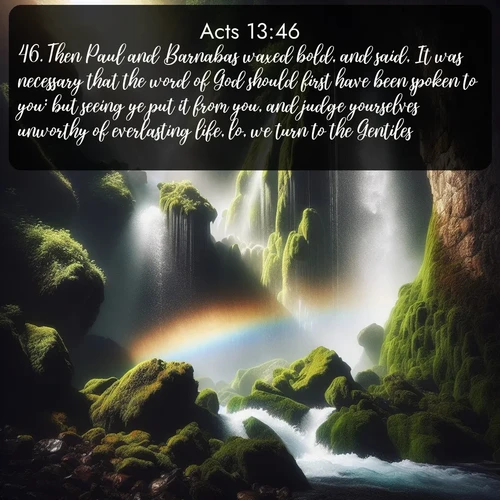
46. Then Paul and Barnabas waxed bold, and said, It was necessary that the word of God should first have been spoken to you: but seeing ye put it from you, and judge yourselves unworthy of everlasting life, lo, we turn to the Gentiles.
Sermons Related to this Bible Chapter - Paul and Barnabas' Ministry and Persecution
:Back to Index
 Acts 14:5-6 ).' />
 Acts 14:5-6 ).' />
 Acts 13:3-4 ).' />
 Acts 14:1-7 ).' />
 Acts 13:46 ).' />
 Acts 14:5-6 ).' />
 Acts 13:4-12 ).' />
 Acts 14:8-20 ).' />
 Acts 14:19-20 ).' />
 Acts 14:21-23 ).' />
 Acts 13:1-3 ).' />
 Acts 13:43-44 ).' />
 Acts 14:19-20 ).' />


NOTE: The images reflect the following descriptions related to the theme : Paul and Barnabas' Ministry and Persecution
- Macro close-up of Paul's hands, calloused and worn from labor and travel, clutching a worn scroll of the scriptures. Dust motes dance in a shaft of sunlight piercing a dimly lit room. The scroll shows faint traces of Hebrew script.
- Macro close-up of a Roman soldier's weathered boot, stained with mud and blood, standing on a cobblestone street in a bustling marketplace. A discarded fragment of a torn letter, bearing the name 'Paul', lies near the boot.
- Bright morning light illuminates a sun-drenched olive grove in Cyprus. Paul and Barnabas, silhouetted against the golden light, are preaching to a small group of attentive listeners. Olive branches and scattered stones are visible.
- Morning sunlight bathes a field of wheat near Lystra. A single crow flies overhead, the only movement in the otherwise peaceful scene. Paul and Barnabas, having just performed a miracle, are leaving the small village. The wheat is golden with the sunrise.
- Evening scene in a bustling Roman marketplace. Shadows lengthen as Paul and Barnabas argue with a group of angry townspeople. A flickering oil lamp casts a warm light on their faces, revealing their determination and exhaustion.
- An evening sky, ablaze with fiery oranges and reds, casts long shadows across a dusty road leading out of Iconium. Paul and Barnabas, having escaped persecution, are walking away from the setting sun with their faces turned towards the horizon.
- A bustling early morning street scene in Antioch. Paul and Barnabas, surrounded by a crowd of people of different ethnicities, are sharing the Gospel. Their faces show enthusiasm and confidence; a bustling marketplace is behind them.
- People gather in the morning at a well outside a small village, waiting for Paul and Barnabas. Water jugs and baskets of food are present. The well is the central element of this scene and represents the importance of the gospel.
- Night scene: Paul and Barnabas, huddled together in a dark prison cell, pray fervently. A single ray of moonlight shines through a barred window, highlighting their weary faces and their steadfast faith. A simple wooden pallet is in the corner.
- Night scene: A group of Roman soldiers are pursuing Paul and Barnabas through the dark, narrow streets of a city. Torches cast flickering shadows, creating a sense of urgency and danger. The stone buildings loom large against the dark sky.
- A close-up of a simple wooden staff, its wood worn smooth by years of travel, lying in the dust next to a worn leather satchel. A few coins and a small, folded map are on the ground nearby. Symbols of a missionary’s life.
- A field of wildflowers, vibrant and colorful, in bloom in the midst of a rocky landscape. This field represents the hope and resilience of the Gospel, even amidst hardship and persecution. The wildflowers are of varying types, representing different peoples.
General themes for this chapter of the Bible: Paul and Barnabas Sent; Preaching in Cyprus; Paul's Sermon in Pisidian Antioch
A link to this resource is much appreciated to let others know about this free christian resource. The AB Church in LAusanne-Renens is happy to make the image collection available for free.
Other Galleries for this theme / Bible book
Paul's First Missionary Journey: Spreading the Gospel


Ananias and Sapphira: A Lie Detected
Appointment of the Seven Deacons
Ascension of Jesus and the Choosing of Matthias
Conversion of Saul: A Blinding Light on the Road to Damascus
Healing of the Lame Man: Peter's Powerful Proclamation
James' Martyrdom and Peter's Escape
Jerusalem Council: A Gathering of Believers
Paul and Barnabas' Ministry and Persecution
Paul's Journey: From Corinth to Antioch
Paul's Missionary Journeys: Thessalonica, Berea, and Athens
Paul's First Missionary Journey: Spreading the Gospel
Paul's Journey: From Jerusalem to Rome
Paul's Ministry in Ephesus: Transforming Lives
Paul's Second Missionary Journey: Conversions in Philippi
Pentecost: Peter's Sermon and the Gift of the Holy Spirit
Peter and Cornelius: A Godly Vision
Peter and John Before the Sanhedrin
Peter Defends Gentile Inclusion
Philip's Ministry in Samaria and the Ethiopian Eunuch
Stephen's Martyrdom and the Early Church
Related Pages: thematic Bible Images (French Version)