
Thematic Bible Images

Ahaz's Idolatry: A King's Fall

King Ahaz, consumed by fear and neglecting the Lord, turned to pagan practices, sacrificing his sons in the fire and building altars to foreign gods. His actions led Judah further away from God's covenant.

Ahaz's Idolatry: A King's Fall

2 Kings (4 Kings) 16:1-4


1. In the seventeenth year of Pekah the son of Remaliah Ahaz the son of Jotham king of Judah began to reign.
2. Twenty years old was Ahaz when he began to reign, and reigned sixteen years in Jerusalem, and did not that which was right in the sight of the LORD his God, like David his father.
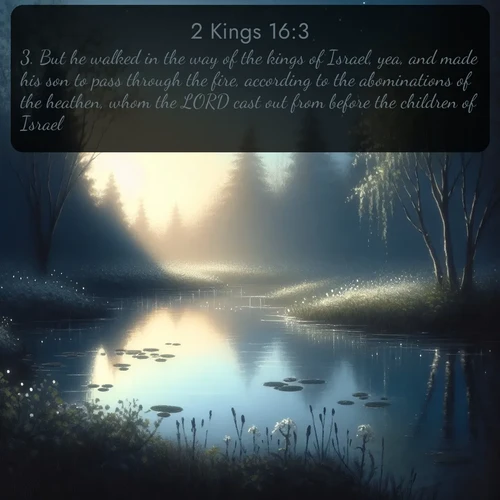
3. But he walked in the way of the kings of Israel, yea, and made his son to pass through the fire, according to the abominations of the heathen, whom the LORD cast out from before the children of Israel.
4. And he sacrificed and burnt incense in the high places, and on the hills, and under every green tree.


Back to Index

Night:  A solitary watchman silently observes from a distant rooftop the scene of pagan worship taking place within the city walls, his face partially shadowed, creating a sense of loneliness and helplessness.  Emphasizes the isolation and helplessness in the face of widespread idolatry.Night:  A solitary watchman silently observes from a distant rooftop the scene of pagan worship taking place within the city walls, his face partially shadowed, creating a sense of loneliness and helplessness.  Emphasizes the isolation and helplessness in the face of widespread idolatry.Depict the subtle contrast between the elaborate, ornate carvings of Ahaz's pagan altars and the simple, yet powerful, design of the altar of the Lord, showing the difference in focus, highlighting the aesthetic clash between true worship and idolatry without explicit representations of figures.  Uses symbolism to convey the difference between true and false worship without direct depiction of figures or religious acts.
Illustrate the imagery of Ahaz's actions of sacrificing his sons through the use of a heavily symbolized image, such as a dying tree with its branches bearing the shape of small human figures, placed alongside images of a foreign deity symbol, emphasizing the theme without explicitly showing the act of sacrifice.  Uses symbolism to emphasize the sacrifice of Ahaz's sons without graphic imagery.A macro close-up of a meticulously carved Asherah pole, its surface adorned with intricate symbols of pagan worship, showcasing the detail of idolatrous craftsmanship, contrasting with the rough texture of the surrounding soil.  The focus is solely on the materiality and artistry of the idol.  Focuses on the craftsmanship of idols, highlighting the material aspect of idolatry as described in <a href=2 Kings 16 .' />Bright morning sunlight bathes a lush field near Jerusalem.  In the distance, the silhouette of a pagan altar stands amidst olive trees, casting a long shadow that reaches towards a small, struggling fig tree.  The scene illustrates the encroachment of idolatry upon the land.  Shows idolatry's encroachment upon the natural world, reflecting the spiritual corruption described in <a href=2 Kings 16 .' />
A vibrant sunrise illuminates a rocky hillside overlooking the Kidron Valley.  Wildflowers bloom defiantly near a weathered, abandoned stone altar, its surface cracked and overgrown with weeds. This represents the natural world reclaiming space from Ahaz's pagan practices.  Illustrates the decay of pagan altars, contrasting with the vitality of nature and hinting at divine judgment.As the sun sets, casting long shadows, a lone figure walks away from a distant, smoldering altar, leaving behind only ash and the lingering scent of sacrifice.  The scene emphasizes the isolation and regret following idolatrous acts.  Captures the desolation and isolation following idolatrous acts, mirroring the spiritual consequences described in <a href=2 Kings 16 .' />An evening scene: The faint light of the setting sun illuminates the desolate, abandoned temple of Molech, overgrown with thorny bushes and weeds, signifying decay and desolation caused by idolatry.  A raven perched on a crumbling pillar adds to the scene's atmosphere of despair.  Depicts the decay and abandonment of pagan temples, signifying the decline of Ahaz's idolatry.
A group of people in the early morning light gather near a freshly built pagan altar, their faces obscured by the rising sun, performing a ritualistic offering of fruits and grains.  The scene shows the community's participation in Ahaz's idolatry.  Shows the communal nature of Ahaz's idolatry and its widespread acceptance within society.Morning:  Several people, dressed in simple robes, silently prepare a child for sacrifice, their faces etched with a mixture of fear and resignation. The scene portrays the dark reality of human sacrifice under Ahaz's reign.  Illustrates the horrific act of child sacrifice and the complicity of those involved.Night scene:  The flickering flames of many sacrificial fires illuminate the faces of several individuals involved in a nocturnal pagan ritual within the walls of Jerusalem, showcasing the secrecy and darkness of their actions.  Highlights the secretive and nocturnal nature of pagan rituals, contrasting with the open worship of the Lord.
 overlayed with the bible verse  1. In the seventeenth year of Pekah the son of Remaliah Ahaz the son of Jotham king of Judah began to reign.
 overlayed with the bible verse  1. In the seventeenth year of Pekah the son of Remaliah Ahaz the son of Jotham king of Judah began to reign.
 overlayed with the bible verse  1. In the seventeenth year of Pekah the son of Remaliah Ahaz the son of Jotham king of Judah began to reign.
 overlayed with the bible verse  1. In the seventeenth year of Pekah the son of Remaliah Ahaz the son of Jotham king of Judah began to reign.
 overlayed with the bible verse  1. In the seventeenth year of Pekah the son of Remaliah Ahaz the son of Jotham king of Judah began to reign.
 overlayed with the bible verse  1. In the seventeenth year of Pekah the son of Remaliah Ahaz the son of Jotham king of Judah began to reign.
 overlayed with the bible verse  1. In the seventeenth year of Pekah the son of Remaliah Ahaz the son of Jotham king of Judah began to reign.
 overlayed with the bible verse  1. In the seventeenth year of Pekah the son of Remaliah Ahaz the son of Jotham king of Judah began to reign.
 overlayed with the bible verse  1. In the seventeenth year of Pekah the son of Remaliah Ahaz the son of Jotham king of Judah began to reign.
 overlayed with the bible verse  1. In the seventeenth year of Pekah the son of Remaliah Ahaz the son of Jotham king of Judah began to reign.
 overlayed with the bible verse  1. In the seventeenth year of Pekah the son of Remaliah Ahaz the son of Jotham king of Judah began to reign.

NOTE: The images reflect the following descriptions related to the theme : Ahaz's Idolatry: A King's Fall

  • A macro close-up of a meticulously carved Asherah pole, its surface adorned with intricate symbols of pagan worship, showcasing the detail of idolatrous craftsmanship, contrasting with the rough texture of the surrounding soil. The focus is solely on the materiality and artistry of the idol.
  • A macro close-up of a charred offering, perhaps a small animal bone, resting amongst scattered ashes on a stone altar. The focus is on the grim reality of child sacrifice, depicting the burnt remains in detail, against the dark and smoky background.
  • Bright morning sunlight bathes a lush field near Jerusalem. In the distance, the silhouette of a pagan altar stands amidst olive trees, casting a long shadow that reaches towards a small, struggling fig tree. The scene illustrates the encroachment of idolatry upon the land.
  • A vibrant sunrise illuminates a rocky hillside overlooking the Kidron Valley. Wildflowers bloom defiantly near a weathered, abandoned stone altar, its surface cracked and overgrown with weeds. This represents the natural world reclaiming space from Ahaz's pagan practices.
  • As the sun sets, casting long shadows, a lone figure walks away from a distant, smoldering altar, leaving behind only ash and the lingering scent of sacrifice. The scene emphasizes the isolation and regret following idolatrous acts.
  • An evening scene: The faint light of the setting sun illuminates the desolate, abandoned temple of Molech, overgrown with thorny bushes and weeds, signifying decay and desolation caused by idolatry. A raven perched on a crumbling pillar adds to the scene's atmosphere of despair.
  • A group of people in the early morning light gather near a freshly built pagan altar, their faces obscured by the rising sun, performing a ritualistic offering of fruits and grains. The scene shows the community's participation in Ahaz's idolatry.
  • Morning: Several people, dressed in simple robes, silently prepare a child for sacrifice, their faces etched with a mixture of fear and resignation. The scene portrays the dark reality of human sacrifice under Ahaz's reign.
  • Night scene: The flickering flames of many sacrificial fires illuminate the faces of several individuals involved in a nocturnal pagan ritual within the walls of Jerusalem, showcasing the secrecy and darkness of their actions.
  • Night: A solitary watchman silently observes from a distant rooftop the scene of pagan worship taking place within the city walls, his face partially shadowed, creating a sense of loneliness and helplessness.
  • Depict the subtle contrast between the elaborate, ornate carvings of Ahaz's pagan altars and the simple, yet powerful, design of the altar of the Lord, showing the difference in focus, highlighting the aesthetic clash between true worship and idolatry without explicit representations of figures.
  • Illustrate the imagery of Ahaz's actions of sacrificing his sons through the use of a heavily symbolized image, such as a dying tree with its branches bearing the shape of small human figures, placed alongside images of a foreign deity symbol, emphasizing the theme without explicitly showing the act of sacrifice.

General themes for this chapter of the Bible: Sennacherib's Invasion; Hezekiah's Prayer

A link to this resource is much appreciated to let others know about this free christian resource. The AB Church in LAusanne-Renens is happy to make the image collection available for free.


Other Galleries for this theme / Bible book

Ahaz's Idolatry: A King's Fall
Amaziah's Reign: A King's Divided Heart
Elijah's Confrontation with Ahaziah
Elijah's Ascension and Elisha's Succession
Elisha and the Aramean Army: Divine Intervention
Elisha's Miracles: A Prophet's Power
The Fall of Israel: A Kingdom Divided
Hazael's Rise and Elisha's Prophecy
Hezekiah and Sennacherib: A Kingdom Under Siege
Hezekiah's Reforms: A King's Devotion
Jehoahaz and Jehoash: A Divided Kingdom
Jehu Anointed King
Joash Crowned King
Joash's Temple Repairs
Judah's Decline and Exile: A Kingdom's Fall
Moab's Rebellion Against Israel
Naaman's Healing: Cleansing and Faith
Reigns of Azariah and Others: A Time of Kings
Siege of Samaria Lifted
Related Nature Images With Bible Verses

Related Nature Images With Bible Verses

Visit other nature images in 2 Kings 16

Related Pages: thematic Bible Images (French Version)