
Thematic Bible Images

Woes to Ephraim and Jerusalem

Isaiah prophesies judgment upon Ephraim (the northern kingdom of Israel) and Jerusalem (the southern kingdom of Judah) for their idolatry, injustice, and rebellion against God.

Woes to Ephraim and Jerusalem

Isaiah 1:1-9


1. The vision of Isaiah the son of Amoz, which he saw concerning Judah and Jerusalem in the days of Uzziah, Jotham, Ahaz, and Hezekiah, kings of Judah.
2. Hear, O heavens, and give ear, O earth: for the LORD hath spoken, I have nourished and brought up children, and they have rebelled against me.
3. The ox knoweth his owner, and the ass his master's crib: but Israel doth not know, my people doth not consider.
4. Ah sinful nation, a people laden with iniquity, a seed of evildoers, children that are corrupters: they have forsaken the LORD, they have provoked the Holy One of Israel unto anger, they are gone away backward.
5. Why should ye be stricken any more? ye will revolt more and more: the whole head is sick, and the whole heart faint.
6. From the sole of the foot even unto the head there is no soundness in it; but wounds, and bruises, and putrifying sores: they have not been closed, neither bound up, neither mollified with ointment.
7. Your country is desolate, your cities are burned with fire: your land, strangers devour it in your presence, and it is desolate, as overthrown by strangers.
8. And the daughter of Zion is left as a cottage in a vineyard, as a lodge in a garden of cucumbers, as a besieged city.
9. Except the LORD of hosts had left unto us a very small remnant, we should have been as Sodom, and we should have been like unto Gomorrah.


Back to Index

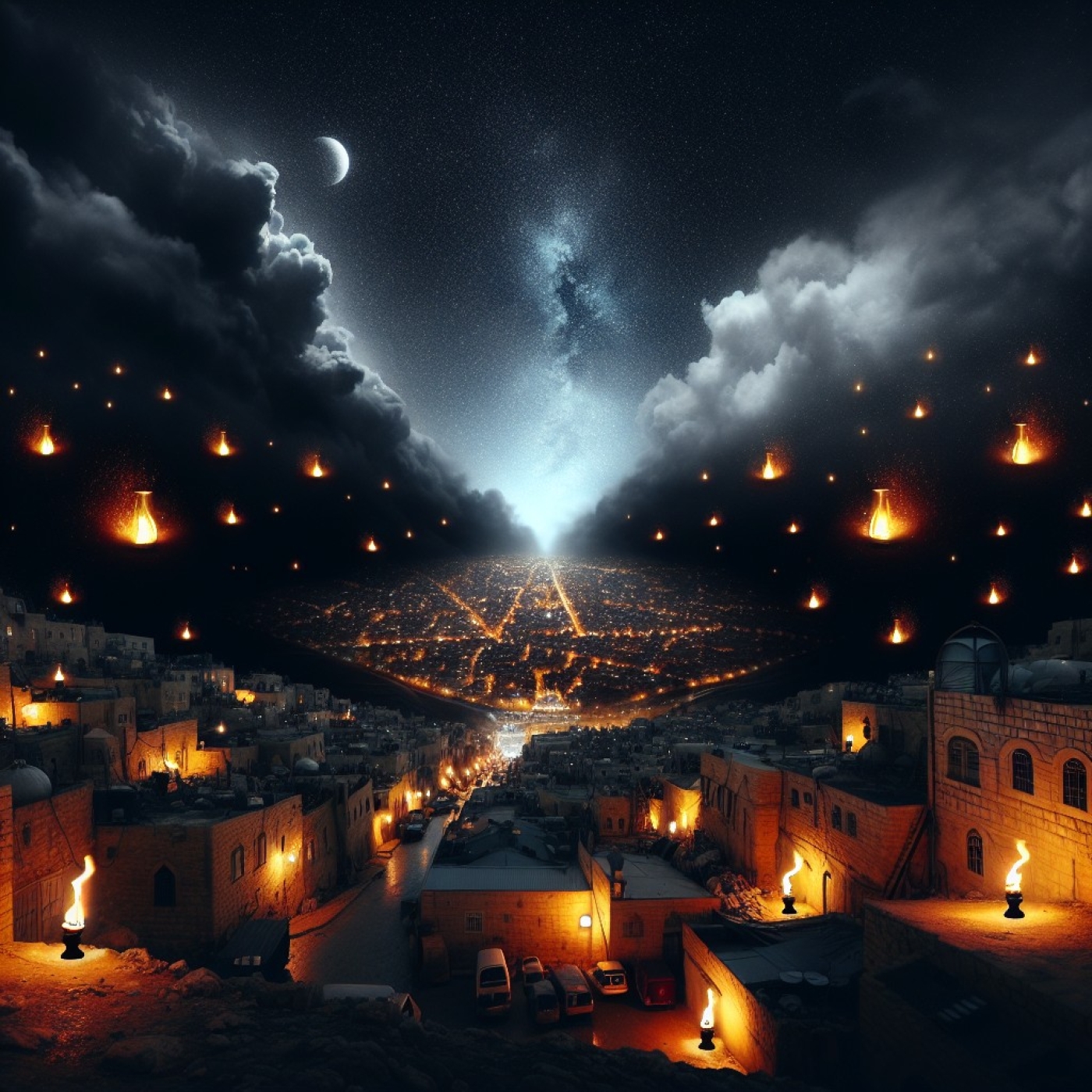
Night scene showing a lone watchman overlooking a deserted city. His silhouette stands out against the moonlit sky, symbolizing the emptiness and despair resulting from divine judgement.  The ruins below are shrouded in darkness.  This emphasizes the desolation and emptiness left after the judgment, highlighting the watchman as a symbol of the remnant left to bear witness to God’s judgment.Night scene showing a lone watchman overlooking a deserted city. His silhouette stands out against the moonlit sky, symbolizing the emptiness and despair resulting from divine judgement.  The ruins below are shrouded in darkness.  This emphasizes the desolation and emptiness left after the judgment, highlighting the watchman as a symbol of the remnant left to bear witness to God’s judgment.A detailed depiction of a broken sacrificial altar overgrown with weeds, symbolizing the abandonment of true worship and the rejection of God's covenant.  The altar’s crumbling stones are intertwined with wild plants, underscoring the passage of time and the neglect of religious duty.  The overgrown sacrificial altar directly represents the abandonment of true worship and covenant, visually expressing themes from Isaiah's prophesies.
A close-up view of a crumbling stone tablet with partially erased Hebrew inscriptions, representing the fading memory of God's law and the people's forgetting of their covenant with Him.  The cracked and worn surface reflects the passage of time and the decay of societal values.  The crumbling tablet visually represents the fading memory of God's law and the breakdown of the covenant, effectively depicting a central theme in Isaiah's writings.Macro closeup of a withered fig tree, its branches bare and leaves blackened, symbolic of the decay of Ephraim and Jerusalem due to their wickedness.  Cracked earth surrounds the tree, signifying drought and desolation.  A single, wilted grape hangs precariously.  This prompt uses the withered fig tree as a symbol of decay and desolation, mirroring the spiritual and physical decline of Ephraim and Jerusalem as described in Isaiah.Macro closeup of a shattered clay idol, depicting a pagan god, surrounded by dust and debris.  The idol's features are broken and defaced, representing the destruction of false gods and the vanity of idolatry.  Fragments of ancient Hebrew script are visible in the dust.  The shattered idol represents the destruction of false gods and the vanity of idolatry, directly addressing the themes of idolatry and rebellion against God prevalent in the prophecies of Isaiah.
Bright morning sunlight illuminates a parched landscape, with withered crops lying on the cracked earth.  A lone shepherd, dressed in ancient attire, watches over a few gaunt sheep, reflecting the poverty and devastation brought upon the land.  A distant, hazy mountain range adds to the sense of isolation and desolation.  The barren landscape, gaunt sheep, and solitary shepherd illustrate the poverty and devastation resulting from the people's actions, reflecting the consequences described in Isaiah's prophecies. The bright morning highlights the stark contrast between the beauty of creation and the desolation caused by human sin.A bright morning scene of the ruins of an ancient city.  Orange sunlight casts long shadows over crumbled walls and broken columns, symbolic of the destruction of Jerusalem and the fall of the kingdom.  A few wildflowers bravely grow amidst the rubble, hinting at the possibility of future renewal.  The ruined city bathed in the warm morning light speaks of the destruction of Jerusalem, a key event within the context of the prophecies, while the wildflowers subtly hint at the possibility of future restoration.Evening sun casts long shadows over a desolate field of barren crops.  The sky is filled with muted oranges and purples.  A lone figure, cloaked and walking away from the setting sun, represents the hopelessness and exile faced by the people.  The setting sun and desolate field mirror the hopelessness and exile experienced by the Israelites due to their sins, conveying the somber tone of the prophecies. The walking figure represents the journey into exile and abandonment.
An evening scene depicting a dry riverbed.  The sun sets in the background, casting a fiery glow on the cracked riverbed, symbolizing the drying up of the land due to the people’s sins.  The scene shows complete aridity and desolation reflecting the consequences of their actions.  The dry riverbed directly reflects the theme of drought and desolation, a consequence of God's judgment on the people's lack of repentance. The evening scene provides a somber atmosphere that accentuates the severity of the situation.Morning scene: A group of impoverished people, dressed in rags, huddle together in a ruined marketplace.  Their faces are etched with despair and hunger, reflecting the consequences of their transgressions.  The city in the background shows signs of decay.  The impoverished people in the ruined marketplace depict the social and economic consequences of the people's sins and the judgment of God, mirroring the descriptions found in Isaiah's prophecies.Morning scene depicting a heartbroken family, mourning the loss of their home, amidst the ruins of a once-thriving town.  Their clothing is torn and dusty, highlighting their poverty and despair.  The debris from the destroyed homes underlines the scale of the disaster.  This scene emphasizes the human cost of the destruction, focusing on the emotional impact of judgment on families and individuals. It illustrates the human element of Isaiah’s prophecies.
Night scene: A group of people are fleeing from a burning city, illuminated by the flames.  Fear and desperation are depicted on their faces as they carry their meager belongings, representing the chaos and destruction brought about by the judgment of God.  The fleeing people amidst the burning city vividly portrays the destruction and chaos resulting from God's judgment, visually representing the divine consequences of actions and warnings. overlayed with the bible verse  1. The vision of Isaiah the son of Amoz, which he saw concerning Judah and Jerusalem in the days of Uzziah, Jotham, Ahaz, and Hezekiah, kings of Judah.
 overlayed with the bible verse  1. The vision of Isaiah the son of Amoz, which he saw concerning Judah and Jerusalem in the days of Uzziah, Jotham, Ahaz, and Hezekiah, kings of Judah.
 overlayed with the bible verse  1. The vision of Isaiah the son of Amoz, which he saw concerning Judah and Jerusalem in the days of Uzziah, Jotham, Ahaz, and Hezekiah, kings of Judah.
 overlayed with the bible verse  1. The vision of Isaiah the son of Amoz, which he saw concerning Judah and Jerusalem in the days of Uzziah, Jotham, Ahaz, and Hezekiah, kings of Judah.
 overlayed with the bible verse  1. The vision of Isaiah the son of Amoz, which he saw concerning Judah and Jerusalem in the days of Uzziah, Jotham, Ahaz, and Hezekiah, kings of Judah.
 overlayed with the bible verse  1. The vision of Isaiah the son of Amoz, which he saw concerning Judah and Jerusalem in the days of Uzziah, Jotham, Ahaz, and Hezekiah, kings of Judah.
 overlayed with the bible verse  1. The vision of Isaiah the son of Amoz, which he saw concerning Judah and Jerusalem in the days of Uzziah, Jotham, Ahaz, and Hezekiah, kings of Judah.
 overlayed with the bible verse  1. The vision of Isaiah the son of Amoz, which he saw concerning Judah and Jerusalem in the days of Uzziah, Jotham, Ahaz, and Hezekiah, kings of Judah.
 overlayed with the bible verse  1. The vision of Isaiah the son of Amoz, which he saw concerning Judah and Jerusalem in the days of Uzziah, Jotham, Ahaz, and Hezekiah, kings of Judah.
 overlayed with the bible verse  1. The vision of Isaiah the son of Amoz, which he saw concerning Judah and Jerusalem in the days of Uzziah, Jotham, Ahaz, and Hezekiah, kings of Judah.
 overlayed with the bible verse  1. The vision of Isaiah the son of Amoz, which he saw concerning Judah and Jerusalem in the days of Uzziah, Jotham, Ahaz, and Hezekiah, kings of Judah.
 overlayed with the bible verse  1. The vision of Isaiah the son of Amoz, which he saw concerning Judah and Jerusalem in the days of Uzziah, Jotham, Ahaz, and Hezekiah, kings of Judah.

NOTE: The images reflect the following descriptions related to the theme : Woes to Ephraim and Jerusalem

  • Macro closeup of a withered fig tree, its branches bare and leaves blackened, symbolic of the decay of Ephraim and Jerusalem due to their wickedness. Cracked earth surrounds the tree, signifying drought and desolation. A single, wilted grape hangs precariously.
  • Macro closeup of a shattered clay idol, depicting a pagan god, surrounded by dust and debris. The idol's features are broken and defaced, representing the destruction of false gods and the vanity of idolatry. Fragments of ancient Hebrew script are visible in the dust.
  • Bright morning sunlight illuminates a parched landscape, with withered crops lying on the cracked earth. A lone shepherd, dressed in ancient attire, watches over a few gaunt sheep, reflecting the poverty and devastation brought upon the land. A distant, hazy mountain range adds to the sense of isolation and desolation.
  • A bright morning scene of the ruins of an ancient city. Orange sunlight casts long shadows over crumbled walls and broken columns, symbolic of the destruction of Jerusalem and the fall of the kingdom. A few wildflowers bravely grow amidst the rubble, hinting at the possibility of future renewal.
  • Evening sun casts long shadows over a desolate field of barren crops. The sky is filled with muted oranges and purples. A lone figure, cloaked and walking away from the setting sun, represents the hopelessness and exile faced by the people.
  • An evening scene depicting a dry riverbed. The sun sets in the background, casting a fiery glow on the cracked riverbed, symbolizing the drying up of the land due to the people’s sins. The scene shows complete aridity and desolation reflecting the consequences of their actions.
  • Morning scene: A group of impoverished people, dressed in rags, huddle together in a ruined marketplace. Their faces are etched with despair and hunger, reflecting the consequences of their transgressions. The city in the background shows signs of decay.
  • Morning scene depicting a heartbroken family, mourning the loss of their home, amidst the ruins of a once-thriving town. Their clothing is torn and dusty, highlighting their poverty and despair. The debris from the destroyed homes underlines the scale of the disaster.
  • Night scene: A group of people are fleeing from a burning city, illuminated by the flames. Fear and desperation are depicted on their faces as they carry their meager belongings, representing the chaos and destruction brought about by the judgment of God.
  • Night scene showing a lone watchman overlooking a deserted city. His silhouette stands out against the moonlit sky, symbolizing the emptiness and despair resulting from divine judgement. The ruins below are shrouded in darkness.
  • A detailed depiction of a broken sacrificial altar overgrown with weeds, symbolizing the abandonment of true worship and the rejection of God's covenant. The altar’s crumbling stones are intertwined with wild plants, underscoring the passage of time and the neglect of religious duty.
  • A close-up view of a crumbling stone tablet with partially erased Hebrew inscriptions, representing the fading memory of God's law and the people's forgetting of their covenant with Him. The cracked and worn surface reflects the passage of time and the decay of societal values.

General themes for this chapter of the Bible: The vision; Judah's rebellion; Judgment pronouncement; Call to repentance

A link to this resource is much appreciated to let others know about this free christian resource. The AB Church in LAusanne-Renens is happy to make the image collection available for free.


Other Galleries for this theme / Bible book

Judah's Rebellion and Call to Repentance
Oracles Against the Nations: Isaiah's Prophecy
The Song of the Vineyard: Isaiah's Prophecy

Apocalypse and God's Ultimate Victory: Isaiah's Prophecy
Comfort for God's People: Isaiah's Promises
Isaiah's Prophecy: Future Hope and Judgment
God's Final Salvation: A New Creation Dawns
Isaiah's Prophecy: God's Servant and Justice
God's Sovereignty and Deliverance: Isaiah's Prophecy
Hezekiah's Reign and the Assyrian Invasion
Immanuel: Prophecy and Assyrian Threat
Isaiah's Vision and Call: A Prophet's Awakening
Judah's Rebellion and Call to Repentance
Judgment on Assyria: The Fall of a Mighty Empire
Judgment on Babylon: The Fall of a Mighty Empire
Oracles Against the Nations: Isaiah's Prophecy
The Branch from Jesse: Salvation's Promise
Isaiah's Vision: The Future Righteous Kingdom
The Song of the Vineyard: Isaiah's Prophecy
Trust in God, not Egypt: Isaiah's Prophecy
Woes to Ephraim and Jerusalem

Related Nature Images With Bible Verses

Related Nature Images With Bible Verses

Visit other nature images in Isaiah 1

Related Pages: thematic Bible Images (French Version)