Thematic Bible Images

Zechariah's Call to Repentance: Return to the Lord

Zechariah's prophecies urge a return to righteousness and God's covenant. His visions offer hope for restoration and a renewed relationship with God.

Zechariah's Call to Repentance: Return to the Lord

Livre pas trouvé

Back to Index

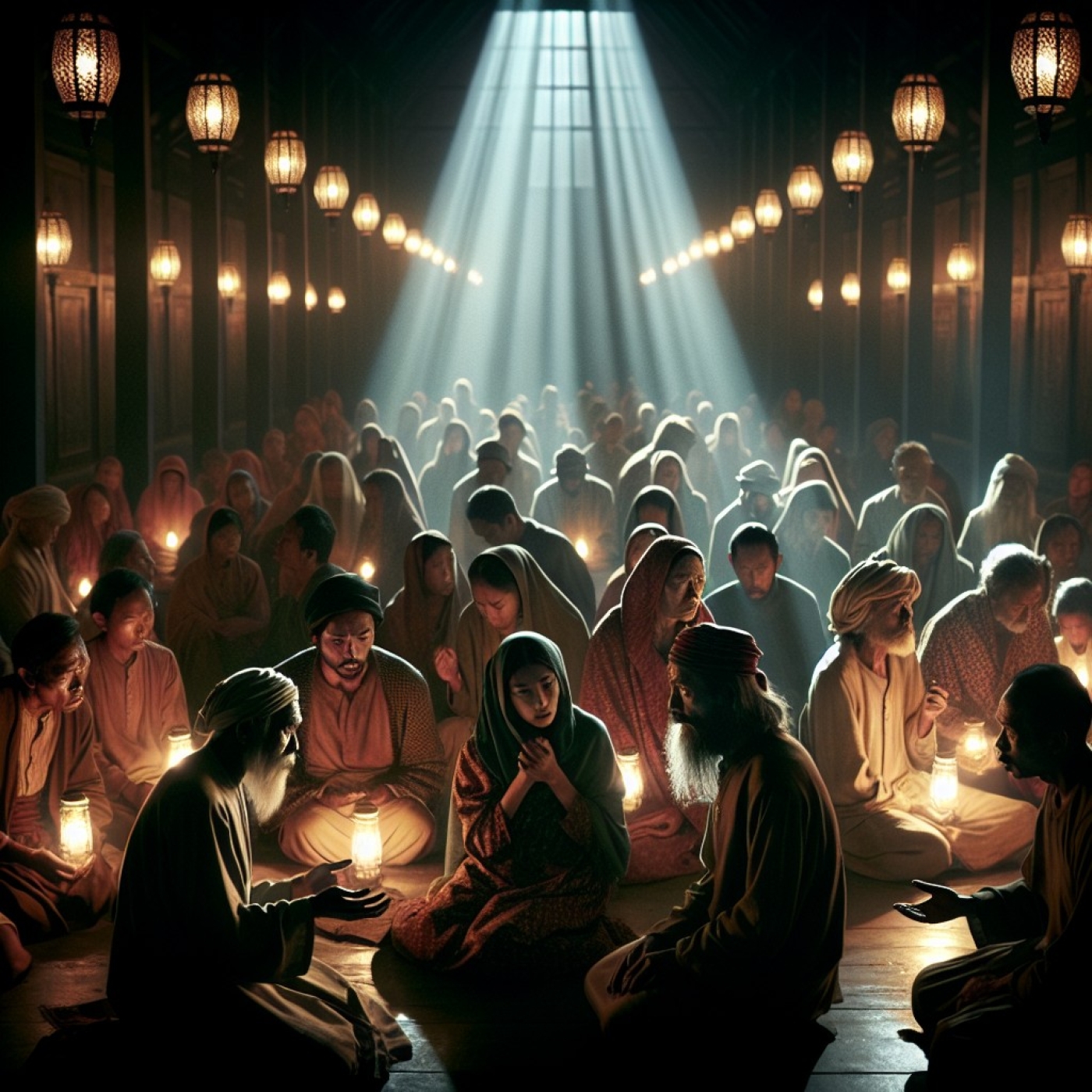
A nighttime scene featuring a group of people huddled together in a dimly lit temple, seeking forgiveness after hearing Zechariah’s harsh prophecy about God’s judgment.   The dimly lit temple represents their spiritual state. The group shows a shared sorrow and a desire for redemption.  The group in the temple illustrates the importance of seeking forgiveness and the collective effort needed in repentance, reflecting the community aspect of the theme.A nighttime scene featuring a group of people huddled together in a dimly lit temple, seeking forgiveness after hearing Zechariah’s harsh prophecy about God’s judgment.   The dimly lit temple represents their spiritual state. The group shows a shared sorrow and a desire for redemption.  The group in the temple illustrates the importance of seeking forgiveness and the collective effort needed in repentance, reflecting the community aspect of the theme.A close-up of a hand holding a torn scroll with a fragment of Zechariah's prophecy, emphasizing the importance of listening to God's call for repentance.  The torn nature of the scroll depicts the people’s disregard for God’s word, whereas the fragment depicts the urgency of repentance.  The torn scroll emphasizes the importance of hearing and responding to God's word, showing the impact of ignoring His call to repentance.
A detailed depiction of a broken, rusted altar in the middle of a deserted temple, symbolizing the broken covenant and the consequences of unrepentant sin. The altar, overgrown with weeds, depicts the abandonment and desolation of the temple.  The desolation is a reflection of the state of the people’s hearts.  The broken altar symbolizes the broken covenant and the destruction resulting from disobedience and lack of repentance, directly connecting to the judgment found in Zechariah.A macro closeup of a weathered, cracked clay tablet inscribed with the words 'Return to the Lord' in ancient Hebrew script, surrounded by scattered olive branches, symbolizing peace and repentance. The tablet shows signs of age and neglect, reflecting the people's turning away from God.  The branches are partially wilted, mirroring the spiritual state of the people.   This prompt uses the symbolism of a weathered tablet and olive branches to represent the broken covenant and the possibility of renewal through repentance, directly relating to Zechariah's call.A macro closeup of a worn silver coin depicting a single, withered grapevine against a background of barren land. The coin represents the broken covenant and the people's loss of prosperity due to their sins.  The barren land symbolizes the spiritual desolation that results from rejecting God. The single withered vine depicts the loss of the promised blessings.  The worn coin with a withered vine illustrates the consequences of sin and the loss of God's blessings, reflecting the urgent need for repentance as detailed in Zechariah's prophecies.
Bright morning sunlight illuminates a field of wheat, partially harvested, symbolizing the incomplete repentance of the people. The setting sun casts long shadows, reminding viewers of the urgency of repentance. The wheat's ripeness suggests the impending judgment if repentance does not happen.   The partially harvested wheat field symbolizes incomplete repentance and the urgency of complete turning to God, mirroring the themes of judgment and grace in Zechariah.A vibrant sunrise paints the sky in hues of orange and yellow, casting light upon a lone fig tree bearing both ripe and unripe fruit. The ripe fruit signifies the blessings of obedience and repentance, while the unripe fruit signifies the consequences of remaining unrepentant. The abundant, yet mixed, fruit embodies the opportunity for change.  The fig tree with both ripe and unripe fruit illustrates the choice between obedience and disobedience, directly connecting to the concept of repentance and its consequences as described in Zechariah.The setting sun casts long shadows across a desolate landscape of cracked earth, depicting the consequences of ignoring God's call to repentance.  A single, stubborn weed pushes through the cracks.  The scene emphasizes the desolation caused by the people's wickedness.   The desolate landscape illustrates the consequences of unrepentant sin, highlighting the severity of the situation and the urgency of a change of heart as found in Zechariah.
A night scene where the stars are obscured by a dark, stormy sky above a barren valley, representing the spiritual darkness caused by a lack of repentance.  Lightning illuminates a crumbling stone structure which mirrors broken covenants. The barrenness of the land represents the spiritual state of the people.  The stormy sky and crumbling structure symbolize spiritual darkness and the breaking of covenants, reflecting the need for repentance and renewal based on Zechariah's message.A group of people, their faces etched with worry, gather at dawn in a marketplace, discussing the prophet Zechariah's message of repentance.   Their attire is simple and worn, reflecting their hardships.  One person holds a scroll depicting scenes from Zechariah's visions.  This depicts the community's response to Zechariah's message, showing the importance of communal repentance and the impact of the prophet's words.A nighttime scene with a solitary figure standing on a hill overlooking a city shrouded in darkness, representing the isolation that comes with unrepentant sin.  The faint glow of a single lamp within the city adds a glimmer of hope.  The figure is dressed simply, holding an olive branch, symbolizing an opportunity for reconciliation.  The solitary figure represents individual accountability and the potential for reconciliation, reflecting the personal aspect of repentance as emphasized by Zechariah's prophecy.
A group of villagers in simple clothing, their faces solemn, kneel together amidst a withered vineyard in the morning light, praying for forgiveness and repentance.  The withered vines illustrate the desolation that their past actions have wrought.  This depicts the people’s remorse.  This shows communal repentance and the acknowledgment of the community's wrongdoing, directly visualizing the theme of remorse and turning back to God.

NOTE: The images reflect the following descriptions related to the theme : Zechariah's Call to Repentance: Return to the Lord

  • A macro closeup of a weathered, cracked clay tablet inscribed with the words 'Return to the Lord' in ancient Hebrew script, surrounded by scattered olive branches, symbolizing peace and repentance. The tablet shows signs of age and neglect, reflecting the people's turning away from God. The branches are partially wilted, mirroring the spiritual state of the people.
  • A macro closeup of a worn silver coin depicting a single, withered grapevine against a background of barren land. The coin represents the broken covenant and the people's loss of prosperity due to their sins. The barren land symbolizes the spiritual desolation that results from rejecting God. The single withered vine depicts the loss of the promised blessings.
  • Bright morning sunlight illuminates a field of wheat, partially harvested, symbolizing the incomplete repentance of the people. The setting sun casts long shadows, reminding viewers of the urgency of repentance. The wheat's ripeness suggests the impending judgment if repentance does not happen.
  • A vibrant sunrise paints the sky in hues of orange and yellow, casting light upon a lone fig tree bearing both ripe and unripe fruit. The ripe fruit signifies the blessings of obedience and repentance, while the unripe fruit signifies the consequences of remaining unrepentant. The abundant, yet mixed, fruit embodies the opportunity for change.
  • The setting sun casts long shadows across a desolate landscape of cracked earth, depicting the consequences of ignoring God's call to repentance. A single, stubborn weed pushes through the cracks. The scene emphasizes the desolation caused by the people's wickedness.
  • A night scene where the stars are obscured by a dark, stormy sky above a barren valley, representing the spiritual darkness caused by a lack of repentance. Lightning illuminates a crumbling stone structure which mirrors broken covenants. The barrenness of the land represents the spiritual state of the people.
  • A group of people, their faces etched with worry, gather at dawn in a marketplace, discussing the prophet Zechariah's message of repentance. Their attire is simple and worn, reflecting their hardships. One person holds a scroll depicting scenes from Zechariah's visions.
  • A nighttime scene with a solitary figure standing on a hill overlooking a city shrouded in darkness, representing the isolation that comes with unrepentant sin. The faint glow of a single lamp within the city adds a glimmer of hope. The figure is dressed simply, holding an olive branch, symbolizing an opportunity for reconciliation.
  • A group of villagers in simple clothing, their faces solemn, kneel together amidst a withered vineyard in the morning light, praying for forgiveness and repentance. The withered vines illustrate the desolation that their past actions have wrought. This depicts the people’s remorse.
  • A nighttime scene featuring a group of people huddled together in a dimly lit temple, seeking forgiveness after hearing Zechariah’s harsh prophecy about God’s judgment. The dimly lit temple represents their spiritual state. The group shows a shared sorrow and a desire for redemption.
  • A close-up of a hand holding a torn scroll with a fragment of Zechariah's prophecy, emphasizing the importance of listening to God's call for repentance. The torn nature of the scroll depicts the people’s disregard for God’s word, whereas the fragment depicts the urgency of repentance.
  • A detailed depiction of a broken, rusted altar in the middle of a deserted temple, symbolizing the broken covenant and the consequences of unrepentant sin. The altar, overgrown with weeds, depicts the abandonment and desolation of the temple. The desolation is a reflection of the state of the people’s hearts.

General themes for this chapter of the Bible:

A link to this resource is much appreciated to let others know about this free christian resource. The AB Church in LAusanne-Renens is happy to make the image collection available for free.


Related Pages: thematic Bible Images (French Version)